

How Xypex Crystalline Admixtures Help Reduce Permeability, Soil-Induced Corrosion Risk, and Long-Term Durability Failures in Mission-Critical Facilities
Xypex North America
Data centers are among the most mission-critical facilities being built today. As artificial intelligence, cloud computing, and digital infrastructure continue to expand, developers are under pressure to deliver larger facilities faster, often in markets where soil and groundwater conditions may be aggressive or less predictable.
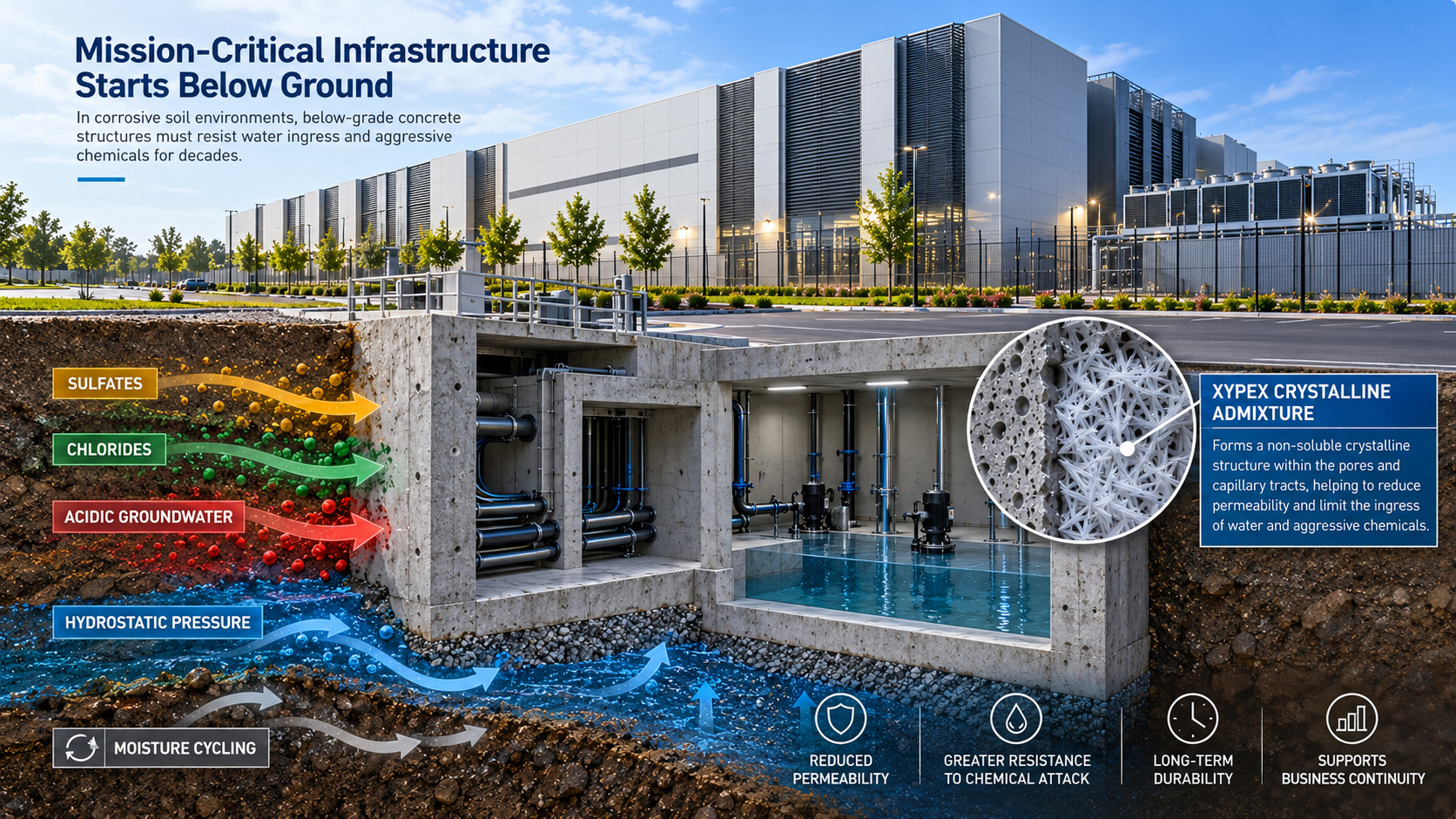
For owners, developers, and engineers, this creates a clear durability challenge. Foundations, below-grade structures, utility vaults, cooling infrastructure, pump pits, and water-retaining concrete elements must perform reliably for decades. In corrosive soil environments where sulfates, chlorides, acidic groundwater, hydrostatic pressure, or aggressive moisture conditions are present, concrete permeability becomes a critical risk factor.
Moisture-related deterioration is not only a concrete durability issue. In a data center environment, it can become a business continuity issue. Water intrusion, reinforcement corrosion, chemical attack, and difficult-to-access repairs can create operational risk long after construction is complete.
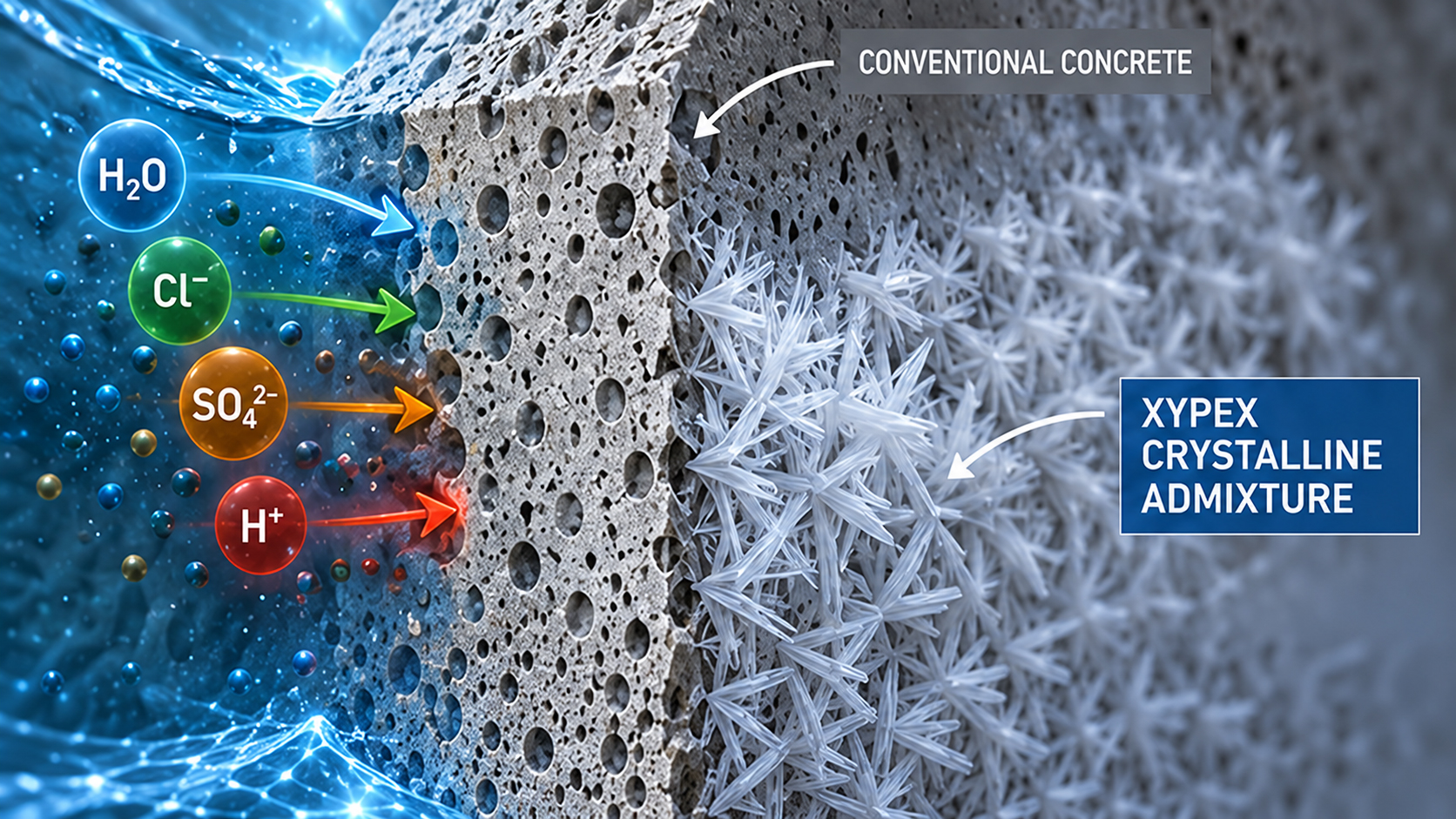
Xypex crystalline admixtures provide an integral approach to waterproofing and concrete protection. Added at the time of batching, Xypex Admix reacts with moisture and cement hydration by-products to form a non-soluble crystalline structure within the pores and capillary tracts of the hardened concrete. This helps reduce permeability and limit water ingress and aggressive chemicals, supporting long-term durability in below-grade and chemically exposed concrete. [1]
The Data Center Durability Challenge
Data centers represent large, and complex infrastructure assets. They often include substations, cooling towers, underground utilities, duct banks, pump pits, generator pads, chilled-water infrastructure, below-grade vaults, retaining walls, equipment galleries, and stormwater or process-water structures which ensures optimal performance and reliability in supporting modern technological demands.
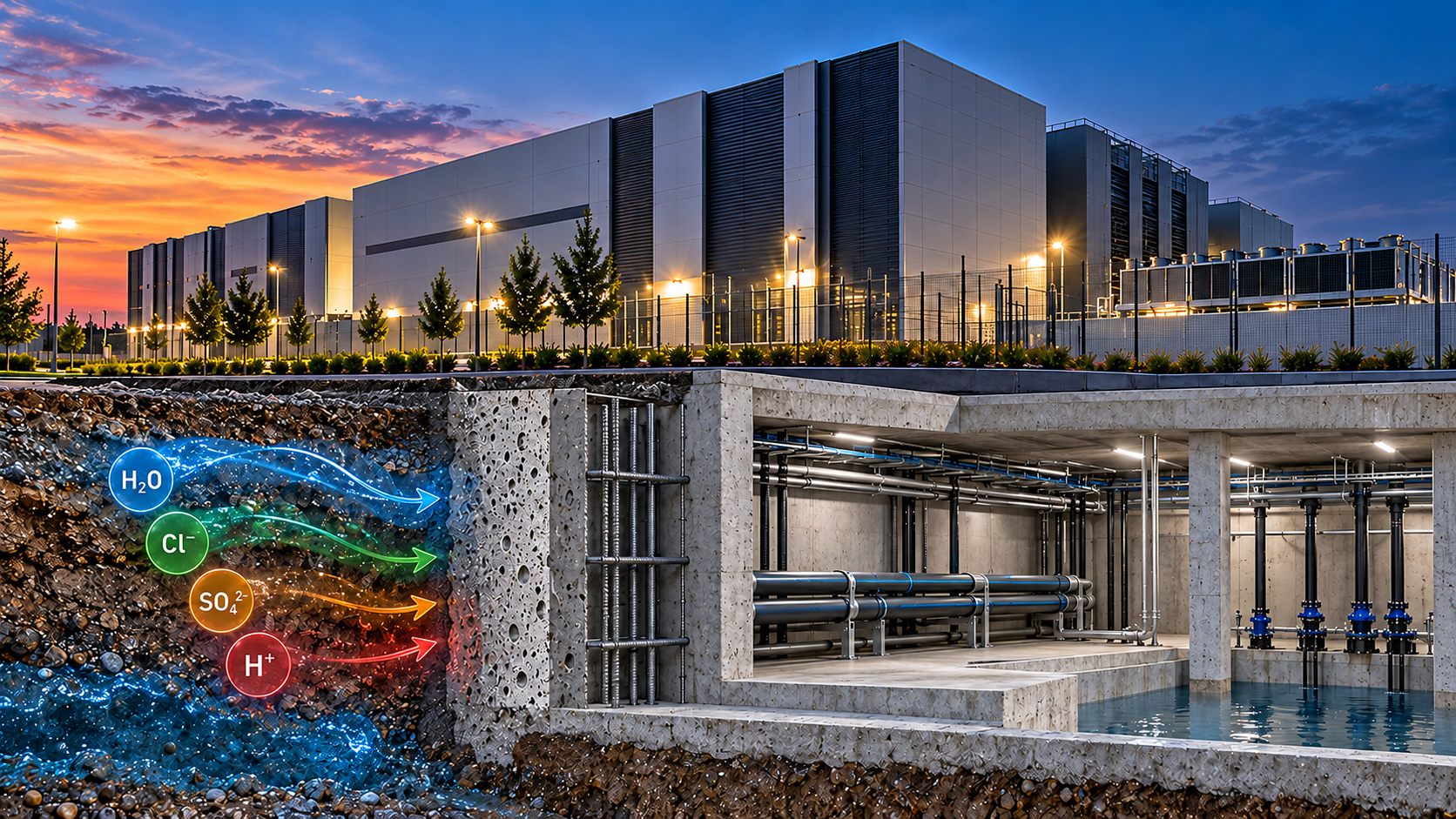
Many of these concrete elements are below grade, in contact with groundwater, or exposed to chemically aggressive environments. In corrosive soils, exposure may include sulfates, chlorides, acidic groundwater, hydrostatic pressure, and moisture cycling.
- Sulfates can contribute to expansion, cracking, softening, and loss of concrete integrity.
- Chlorides can penetrate concrete cover and accelerate rebar corrosion when moisture and oxygen are present.
- Acidic groundwater or acidic soils can attack the cementitious matrix and increase surface deterioration.
- Hydrostatic pressure can drive water and dissolved chemicals into cracks, joints, and capillary pores.
- Moisture cycling can intensify the transport of aggressive ions and increase long-term deterioration risk.
ACI and CSA design standards and durability guides requires designers to assign exposure classes for durability, including exposure to sulfates, water contact, and corrosion protection of reinforcement. These durability requirements are intended to reduce the movement of water and dissolved chemicals that can cause long-term concrete deterioration. [2]
For data centers, these challenges are amplified because access for repairs is often limited after the facility is operational. A below-grade vault, cooling tower basin, mat foundation, utility trench, or pump pit may be difficult, disruptive, or costly to remediate once critical equipment is installed and the site is live. It is essential to consider these factors proactively.
Why Corrosive Soils Matter
Concrete durability depends heavily on limiting the movement of water and harmful chemicals. Low-permeability concrete is generally more durable in aggressive exposure conditions because it slows the transport of sulfates, chlorides, acids, and other harmful substances into the concrete matrix. [3]
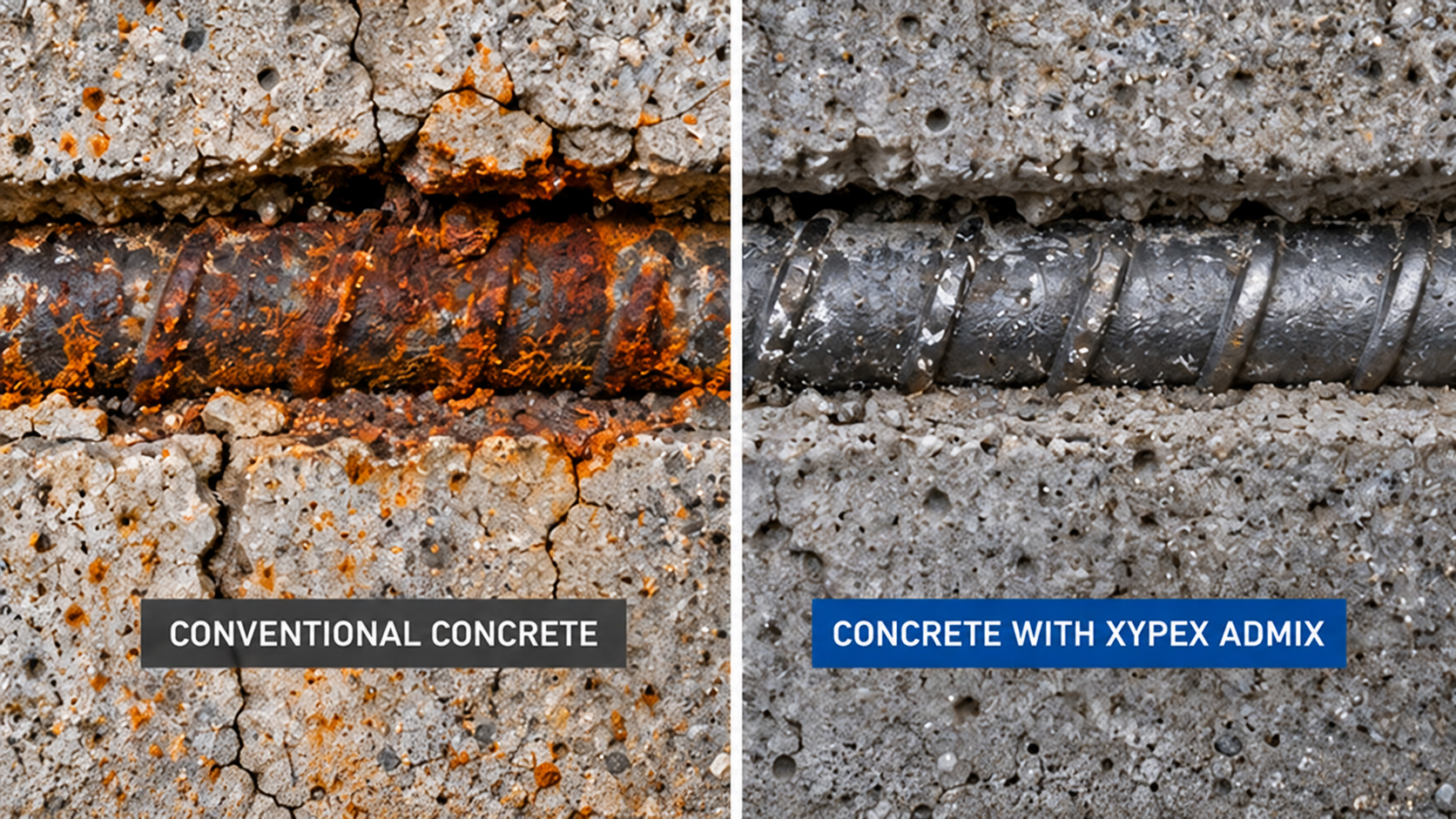
In high-sulfate soils, sulfate ions may penetrate concrete and interact with cement hydration products, potentially forming expansive compounds and physical damage to the structure. Likewise, in chloride-bearing soils or groundwater, chlorides can migrate toward reinforcing steel, increasing the risk of corrosion once threshold levels are reached. Furthermore, in acidic soils or groundwater, the cement paste is susceptible to chemical / sulfate attacks, which over time reduces surface integrity and increases permeability. Understanding these outcomes is essential for maintaining structures durability.
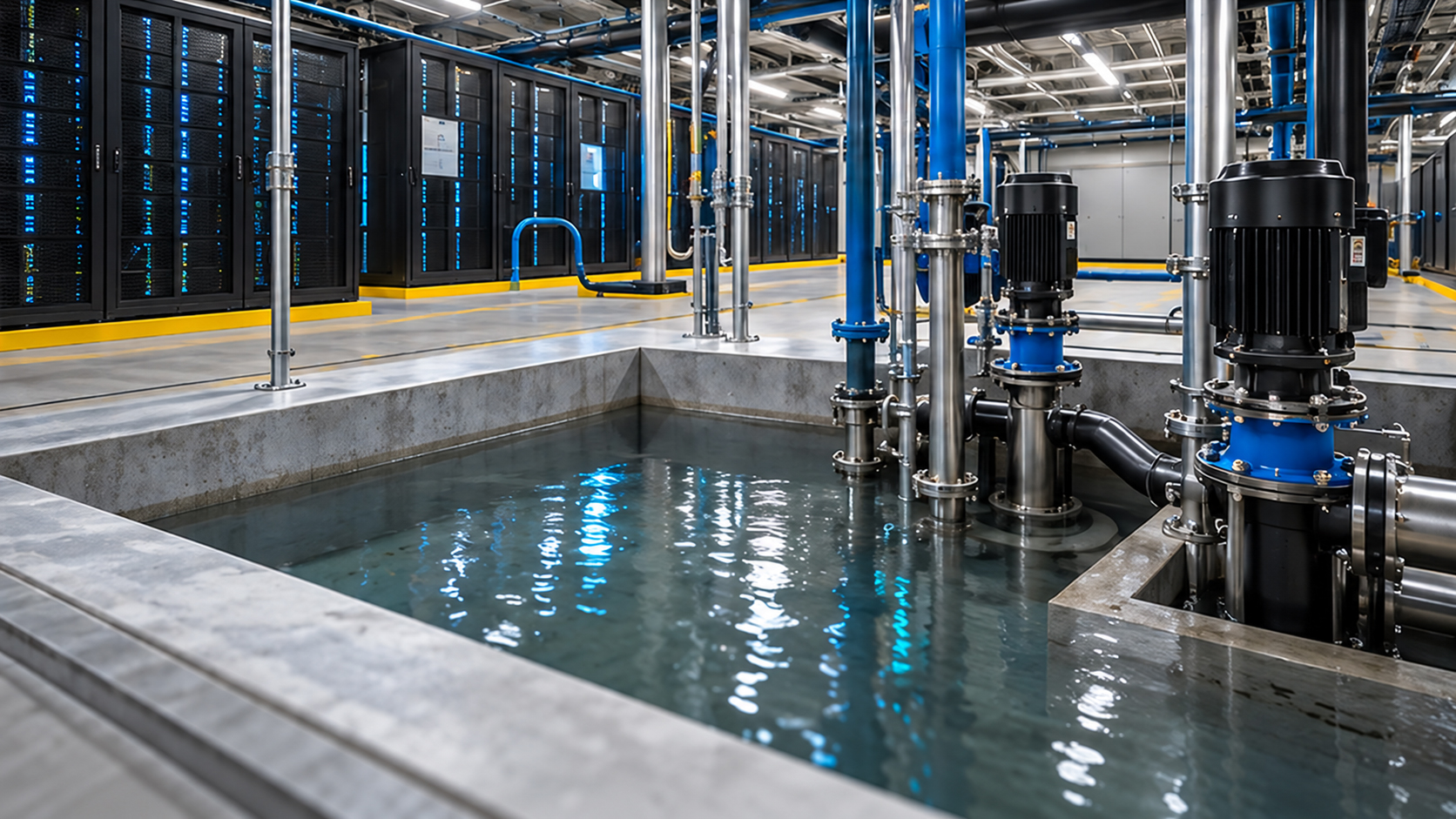
These mechanisms are especially important for data center projects because even localized deterioration can create operational consequences. A leak in a cooling tower basin, utility vault, electrical duct bank, or below-grade equipment area can lead to water intrusion, equipment risk, corrosion of embedded components, environmental concerns, downtime, and expensive remediation.
The practical issue is not only whether concrete can resist exposure on day one. The issue is whether below-grade and chemically exposed concrete can continue performing reliably for the life of the facility.
Integral Protection for Below-Grade Data Center Concrete
Traditional waterproofing systems typically rely on externally applied membranes, coatings, or barriers. These systems can be effective, but they are vulnerable to installation quality, substrate conditions, adverse weather, punctures, seam failures, damage during backfill, which can arise during construction and limit future access.

Xypex Admix takes a different approach because it becomes part of the concrete itself. According to Xypex product data, the admixture is added at the time of batching, and its active chemicals react with moisture and cement hydration by-products to create a non-soluble crystalline formation throughout the pores and capillary tracts of the concrete. This integral crystalline structure helps block the movement of water and other liquids through the concrete. [1] For data centers built on corrosive soils, this approach provides several important advantages.
Reduced permeability
Lower permeability helps reduce the movement of sulfates, chlorides, acidic groundwater, and other aggressive chemicals into the concrete matrix.
Hydrostatic pressure resistance
Xypex-treated concrete has demonstrated exceptional resistance to water pressure in published testing, confirming its effectiveness in below-grade and water-exposed structures. [4]
Chemical resistance
Xypex Admix test data shows exceptional performance under sulfate, chloride, and acidic exposure conditions, reinforcing its effectiveness as a key component of durability strategy in aggressive service environments. [4]
Self-healing of static hairline cracks
Xypex product data reports the ability to self-heal static hairline cracks up to 0.5 mm. This is especially valuable in below-grade concrete, where minor cracking can become a pathway for groundwater and dissolved chemicals to enter. [1]
Schedule and constructability benefits
Incorporating Xypex Admix during batching significantly reduces the need for separate membrane installation, protection boards, weather-sensitive applications, and post-placement waterproofing sequencing. For fast-track data center projects, simplifying the waterproofing process can help reduce schedule risk. [5]
Performance Evidence in Aggressive Environments
Published Xypex product data and technical testing summaries include performance results for corrosive soil exposure, including reduced water permeability, sulfate resistance, reduced chloride diffusion, sulfuric acid resistance, and self-healing capabilities. [4]
In permeability testing, Xypex-treated concrete showed no leakage under 7 bars of pressure for 10 days, while reference samples began leaking during the test period. In another test, Xypex Admix-treated concrete demonstrated a 93% reduction in water permeability at a 1.2% dosage rate. [4]
For sulfate resistance, Xypex-treated samples exposed to a highly concentrated sulfate solution recorded significantly lower mass loss and no visible surface deterioration in contrast to untreated samples [4]
For chloride exposure, testing using sodium chloride solution showed reductions in chloride diffusion coefficients for Xypex-treated fly ash and slag concrete mixes compared with controls. [4]
For acidic exposure, Xypex Admix-treated samples exposed to sulfuric acid showed lower weight loss than untreated controls. In a separate acid-resistance program using 5% sulfuric acid, Xypex Admix C-1000 NF reduced weight loss compared with cement-only mortar controls and fly ash specimens after 12 weeks. [4]
The significance of these results cannot be overstated; a single factor rarely drives the formation of corrosive soil environments. Many sites involve combined exposure: groundwater plus sulfates, chlorides plus moisture, or acidic soil chemistry plus hydrostatic pressure. A durable solution must therefore address permeability as the primary transport mechanism.
Real-World Project Relevance
Public Xypex project references demonstrate how crystalline technology has been used in applications relevant to data center risk profiles.
At Glass City Metropark in Toledo, Ohio, Xypex Admix C-500 was selected for a below-grade utility vault located near the Maumee River, where water infiltration posed a risk to electrical equipment and overall structure functionality. The admixture was selected over traditional membranes to provide long-term protection while supporting project schedule requirements. [6]
At a Data Security Site, a major cellular security facility located against a wet hillside required protection against water intrusion. Xypex products were used where keeping water away from the site was critical. This type of application is directly relevant to data centers, telecom facilities, and other mission-critical infrastructure where below-grade moisture risk can affect operations. [7]
At Lascelles Wharf in Geelong, Australia, Xypex Admix C-Series was used in a challenging marine environment. Long-term third-party testing reported low chloride penetration, no significant carbonation, and extended service-life projections after years of exposure. Although marine exposure differs from data center soil exposure, the project highlights the relevance of permeability reduction and chloride resistance in aggressive environments. [8]
These examples reinforce an important point: when concrete is exposed to groundwater, chlorides, sulfates, hydrostatic pressure, or other aggressive conditions, the durability choices made during mix design can significantly impact long-term performance.
Lifecycle Value and Risk Mitigation
For data center owners, the value of concrete durability is measured over the full life of the facility. The initial cost of waterproofing and durability enhancement is small compared with the potential costs of water intrusion, corrosion-related remediation, operational disruption, or loss of reliability.
Xypex supports lifecycle risk reduction in several ways.
First, it helps reduce moisture ingress by lowering concrete permeability. This helps protect embedded steel, below-grade rooms, utility corridors, vaults, cooling tower basins, pump pits, and foundations from water and chemical intrusion.
Second, it reduces dependence on externally applied systems that may be damaged during construction or become inaccessible after backfilling. Since Xypex is integral to the concrete, it cannot tear, puncture, delaminate, or fail at seams in the same way as an external membrane.
Third, it can simplify construction sequencing. For fast-track data center projects, reducing membrane installation steps can help lower schedule risk, particularly where weather, labour availability, or site access is constrained.
Fourth, it supports long-term resilience. Mission-critical facilities are increasingly evaluated not only on first cost, but also on durability, uptime, maintenance access, environmental risk, and lifecycle performance.
Design and Specification Considerations
Xypex should be specified as part of a complete durability strategy, not as a replacement for proper engineering, mix design, or construction practices.
For data center projects on corrosive soils, the geotechnical investigation should include sulfate levels, chloride content, pH, resistivity, groundwater elevation, seasonal water table variation, and other relevant soil chemistry data. The structural engineer should assign applicable exposure classification for each concrete element, including foundations, slabs, walls, basins, utility vaults, and water-retaining structures.
Concrete mix designs should consider low permeability, appropriate water-to-cementitious materials ratio, supplementary cementitious materials, sulfate-resistant cementitious systems where required, adequate concrete cover, crack control, curing, consolidation, and compatibility with Xypex Admix.
Waterproofing design should also include joint detailing, waterstops, construction joint treatment, penetrations, tie holes, honeycomb repair procedures, and inspection protocols. Xypex product data notes that the use of Admix does not eliminate the need for proper crack control, construction joint detailing, placement, consolidation, curing, or defect repairs. [1]
For highly acidic or unusually aggressive chemical exposure, engineers should confirm the required protection level with Xypex Technical Services and consider whether additional linings, coatings, drainage, or chemical-resistant systems are required.
Conclusion
As data center construction expands into new locations and more challenging sites, corrosive soil conditions should be treated as a front-end design risk. Factors such as high levels of sulfates, chlorides, acidic groundwater, hydrostatic pressure, and moisture cycling can shorten the service life of concrete and increase the risk of costly, difficult-to-access repairs. It is a practical lifecycle strategy for protecting the structures that safeguard mission-critical digital infrastructure.
Source Notes
[1] Xypex Admix C-500/C-500 NF Product Data, Xypex Chemical Corporation. Supports the description of Xypex Admix as a crystalline waterproofing admixture added at batching, its reaction with moisture and cement hydration by-products, the formation of a non-soluble crystalline structure within concrete pores and capillary tracts, its hydrostatic resistance, its integral nature within concrete, its chemical-resistance positioning, self-healing of static hairline cracks up to 0.5 mm, and the design note that Admix does not eliminate the need for proper crack control, joint detailing, consolidation, curing, or repair of defects. ([Xypex global])
[2] NRMCA CIP 44, Durability Requirements for Concrete. Supports the discussion of ACI durability exposure categories, including sulfate exposure, water contact, and corrosion protection of reinforcement. ([NRMCA])
[3] NRMCA TIP 24, Permeability of Concrete. Supports the statement that low permeability is important for concrete exposed to seawater, de-icing salts, damaging substances, and soils where moisture and dissolved chemicals can cause durability problems. ([NRMCA])
[4] Xypex Admix C-1000/C-1000 NF Product Data and Xypex Concrete Waterproofing Testing, Xypex Chemical Corporation. Supports the cited performance data for water permeability reduction, 7-bar pressure testing, up to 93% reduction in water permeability at a 1.2% dosage rate, sulfate resistance, chloride diffusion reduction, sulfuric acid resistance, and self-healing performance. ([Xypex global])
[5] Xypex Admix C-Series Product Information, Xypex Chemical Corporation. Supports the constructability discussion, including that Xypex Admixtures are added at batching and may reduce trades and installation time compared with other waterproofing methods. ([Xypex global])
[6] Glass City Metropark Project Profile, Xypex Global Projects. Supports the project reference for the below-grade utility vault in Toledo, Ohio, including the use of Xypex Admix C-500 at a 2% dosage for approximately 350 cubic yards of concrete and the project team’s objective of addressing water infiltration risk near the Maumee River. ([Xypex global][6])
[7] Data Security Site Project Profile, Xypex USA Projects. Supports the project reference for a major cellular security site located against a wet hillside, where keeping water away from the site was identified as critical. ([Xypex USA])
[8] Lascelles Wharf Facility Upgrade Project Profile, Xypex Global Projects. Supports the project reference for Geelong, Australia, including use of Xypex Admix C-Series, third-party testing in 2014 and 2021, low chloride penetration, no significant carbonation, and service-life estimates of 164 years and later 187 years. ([Xypex global])
To Learn More, Contact our Xypex Head Office.